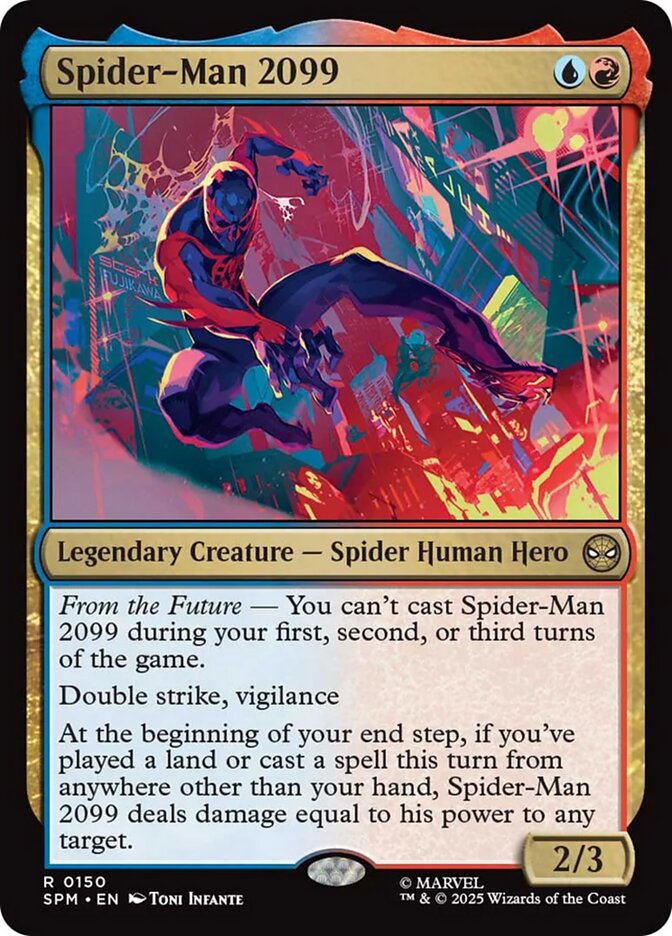
Spider-Man 2099
Since Relic Fest 2025, Spider-Man 2099 has progressively established itself as one of the most represented decks in Duel Commander, while remaining a top contender in the competitive metagame.
While the deck has identifiable weaknesses and can still be attacked effectively, our decision is not based solely on its win rate or raw power level.
Our primary concern is the overall impact of Spider-Man 2099 on the health of the format, archetype diversity, and the deckbuilding constraints it imposes.
The growing presence of Spider-Man 2099 in tournaments has gradually influenced how players build and prepare their decks.
A highly represented deck is not necessarily problematic in itself. However, when its presence forces a significant portion of the format to keep specific answers available or alter their game plan in order to interact with it effectively, its impact goes beyond that of a simple competitive archetype.
Spider-Man 2099 presents precisely this characteristic: its ability to threaten a significant amount of damage very quickly from the command zone creates constant pressure on the opponent.
Its combo threat, accessible through a limited number of cards and backed by the command zone, regularly forces players to keep instant-speed removal available. In many situations, a single answer may not be enough to ensure survival, pushing some decks to include more interaction than they otherwise would.
This pressure is particularly significant in a singleton format, where the ability to consistently access multiple appropriate answers is naturally limited.
The health of a format cannot be measured solely by the number of different decks represented in the top tables. It is also necessary to consider which types of strategies are actually able to remain competitive.
Spider-Man 2099 places particular pressure on decks that seek to win primarily through the board and the combat phase.
Its ability to interact with opposing creatures while simultaneously representing a combo threat from the command zone creates a situation where strategies relying on small creatures or on progressively building a board presence can quickly find themselves at a disadvantage.
This contributes to reducing the space available for aggressive or midrange, board-centric archetypes relying on small and medium-sized creatures.
Over time, this phenomenon pushes the metagame towards decks that are better equipped to meet the specific demands imposed by Spider-Man 2099: decks that can play a significant amount of instant-speed interaction, quickly regain control of the board, or use game plans that directly circumvent its strengths.
We do not believe that this progressive concentration of competitive strategies is desirable for Duel Commander.
A healthy format should allow players to choose their answers based on their own strategy and the overall metagame, rather than forcing them to include an increasing number of cards primarily intended to answer a single archetype.
Spider-Man 2099 creates particular pressure in this regard.
In order to reliably answer its combo, decks often have to dedicate a significant portion of their available slots to instant-speed removal and specific forms of interaction. This constraint is particularly relevant in a singleton format, where every deck slot represents an important decision.
This creates a circle effect:
the more prevalent Spider-Man 2099 becomes, the more players have to adapt their deckbuilding to beat it; the more the format adapts to Spider-Man 2099, the more difficult it becomes to play strategies that cannot accommodate these answers.
This phenomenon mechanically contributes to reducing the true diversity of the format.
Our decision does not mean that Spider-Man 2099 is unbeatable or that there are no strategies capable of defeating it.
The deck has known weaknesses. Instant-speed removal, reanimation strategies, and decks capable of effectively taking over the board with larger bodies can all exploit some of its vulnerabilities.
However, we believe that a card or commander can be problematic even when it is possible to beat it.
The central question is rather what kind of format its presence promotes.
In the case of Spider-Man 2099, we see a combination of problematic factors: significant and growing representation, an easily accessible combo threat from the command zone, substantial pressure on both the number and type of answers required, and a negative impact on the viability of board-centric strategies.
Individually, each of these elements could be acceptable. Taken together, however, they create too much pressure on the metagame as a whole.
We want to preserve a Duel Commander environment in which a wide variety of archetypes can remain competitive: aggressive, midrange, control, and combo decks should be able to coexist without a single commander excessively reducing the available deckbuilding space for others.
We believe that, at this time, Spider-Man 2099 contributes significantly to reducing this diversity and places a level of pressure on deckbuilding that goes beyond what we consider desirable for the long-term health of the format.
For these reasons, and in order to preserve competitive archetype diversity and freedom in deck construction, Spider-Man 2099 is now banned as a commander.