We are overall satisfied with the current state of the Duel Commander. The format currently benefits from a relatively stable metagame and, most importantly, from a level of diversity that we consider healthy, with many competitive strategies coexisting and capable of achieving strong results.
However, some decks seem to be gradually establishing themselves as the primary tier 1 pillars of the current format. We continue to closely monitor commanders such as Spider-Man 2099, Tasigur, the Golden Fang, and Lumra, Bellow of the Woods, all of which have demonstrated particularly strong performances and a significant presence in the current competitive environment.
At this stage, however, we believe the format remains sufficiently open and balanced to allow us to continue our work on experimental unbans.
This stability gives us the opportunity to reintroduce certain historically banned cards into an environment that is now very different from the one that originally led to their banning. Our goal is not to artificially increase the overall power level of the format, but rather to encourage the return of strategies that have disappeared or fallen behind over time, while also enriching the diversity of competitive archetypes available to players.
It is with this philosophy in mind that we are introducing three new experimental unbans today. We hope these returns will allow new decks to emerge, particularly around aggressive, artifact-based, and kindred strategies, all of which have gradually lost representation throughout the recent evolution of the metagame.
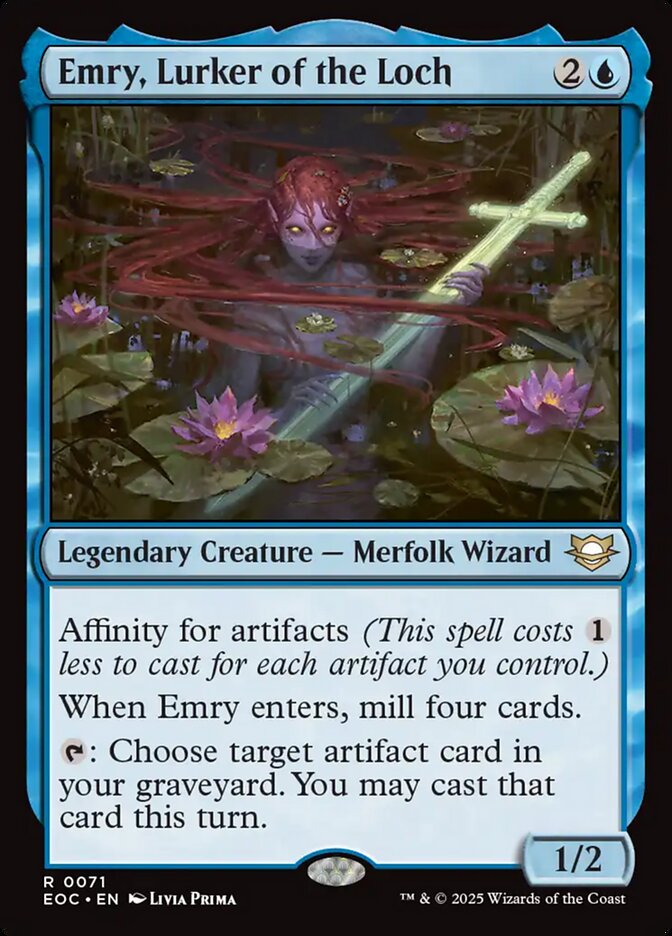
Emry, Lurker of the Loch was banned in November 2019, less than two months after its release. At the time, the format environment was very different: artifact strategies were heavily dominating the metagame. Urza, Lord High Artificer had just been banned, while Sai, Master Thopterist remained a major competitive pillar of the format. Artifact shells benefited from an exceptional density of free mana rocks and from a generally slower environment, allowing Emry to generate massive advantage very early in the game.
Since then, the format has evolved significantly.
First, several of the cards that made Emry particularly explosive are no longer legal. Mox Opal and Lotus Petal have since been banned, greatly reducing the deck’s ability to produce abusive openings and extremely fast combo loops. Emry remains an efficient card, but it no longer benefits from the same environment it had in 2019.
In addition, the overall speed and power level of the format have increased considerably. Today, many commanders are capable of applying immediate pressure, generating card advantage without setup, or threatening very fast kills. Compared to modern Duel Commander standards, Emry no longer appears to be a power-level outlier, but rather a synergistic commander among many others.
At the same time, artifact strategies have lost a significant amount of ground within the metagame. They no longer dominate the format as they did at the time of Emry’s ban, notably because:
free mana engines have been weakened
aggressive and tempo decks have become more efficient
midrange decks now have access to much more flexible and efficient interaction.
The format also has many more natural answers to Emry than it did in 2019. Cheap removal, graveyard hate, and anti-artifact effects are all far more common today. A fast Emry is no longer automatically synonymous with uncontrollable advantage: it dies easily, relies heavily on the graveyard, and often requires several turns before its engine truly becomes profitable.
Additionally, Emry suffers from several structural weaknesses:
it relies heavily on the graveyard, a resource that is now commonly attacked
it requires a very high density of artifacts that are individually low-impact.
It is also important to remember that Emry never truly had the opportunity to be tested in a stabilized environment. Its extremely fast ban was more of a preventive measure in response to a format already weakened by Urza and dominant artifact decks. Seven years later, the format has very little in common with what it was in 2019.
Finally, unbanning Emry would likely bring more diversity than problems. The format currently lacks truly viable competitive artifact commanders. Emry could allow the return of an artifact or control-combo archetype built around value and synergy, without overpowering the current metagame.
For all these reasons, Emry, Lurker of the Loch is now legal as a commander.
Najeela, the Blade-Blossom
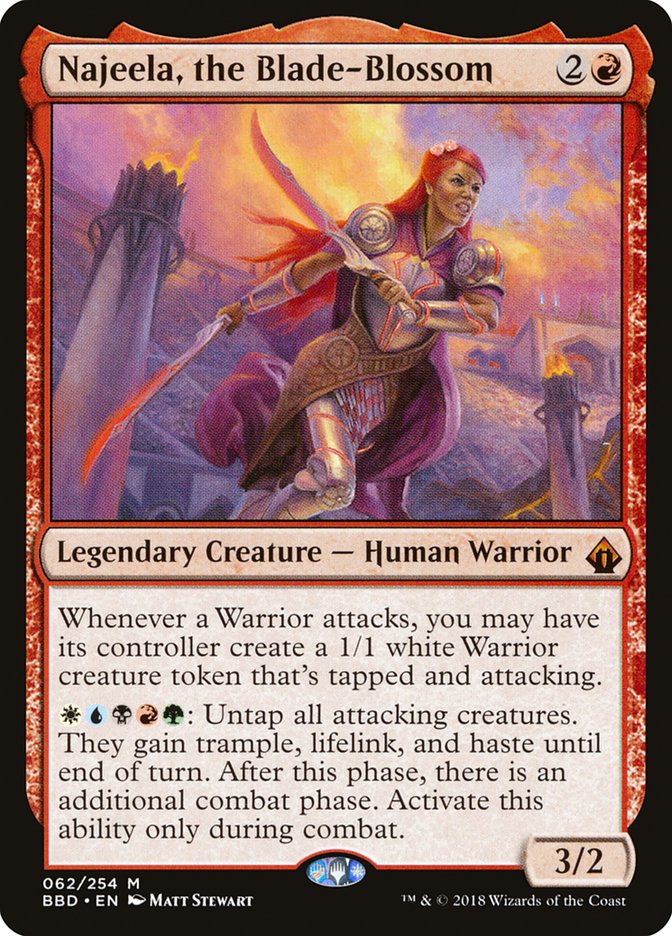
Much like Emry, Lurker of the Loch, Najeela, the Blade-Blossom was banned in 2019, in a format environment very different from the current state of Duel Commander.
At the time, the most successful decks were primarily extremely fast combo strategies or highly explosive aggro decks. Najeela represented a major innovation: it was the first commander to provide access to all five colors while maintaining an extremely low casting cost. Being able to play a five-color commander for only three mana, with just a single colored pip, was considered a significant structural anomaly in deckbuilding at the time.
However, it is important to remember that Najeela never truly had the opportunity to fully dominate the format. It was banned as part of a broader wave of bannings aimed at reducing the overall pressure created by certain archetypes considered unhealthy for the format. The decision was largely preventive and structural in nature rather than a direct response to undeniable dominance.
The deck was primarily built around an aggressive tempo-oriented Warrior strategy capable of snowballing quickly through board pressure and powerful synergies, most notably with Sword of Feast and Famine. This interaction could occasionally generate additional combat steps very early in the game and quickly close out matches.
But once again, the context of the format has changed dramatically since 2019.
Today, there are far more options available for playing aggressive five-color strategies than there were at the time. Simply having access to all five colors is no longer considered a structurally problematic advantage. The average power level of commanders has increased, mana bases have become more efficient, and the format now includes many multicolored commanders capable of generating immediate value or threatening fast kills.
In this context, Najeela appears less like an oppressive threat and more like an opportunity to strengthen the diversity of aggressive strategies within the format, a category that currently occupies a fairly fragile position in the Duel Commander metagame.
Najeela’s game plan also remains highly interactive and heavily exposed to opposing answers, which is an important healthy aspect for the format. While some combo strategies can entirely bypass combat interaction, Najeela must win through the combat step and maintain a consistent board presence in order to function.
Furthermore, its return could allow a true “Warriors” archetype to exist once again, bringing additional diversity to the format without necessarily destabilizing the metagame.
For all these reasons, we believe it is now reasonable to allow Najeela, the Blade-Blossom as a commander on an experimental basis.
Winota, Joiner of Forces
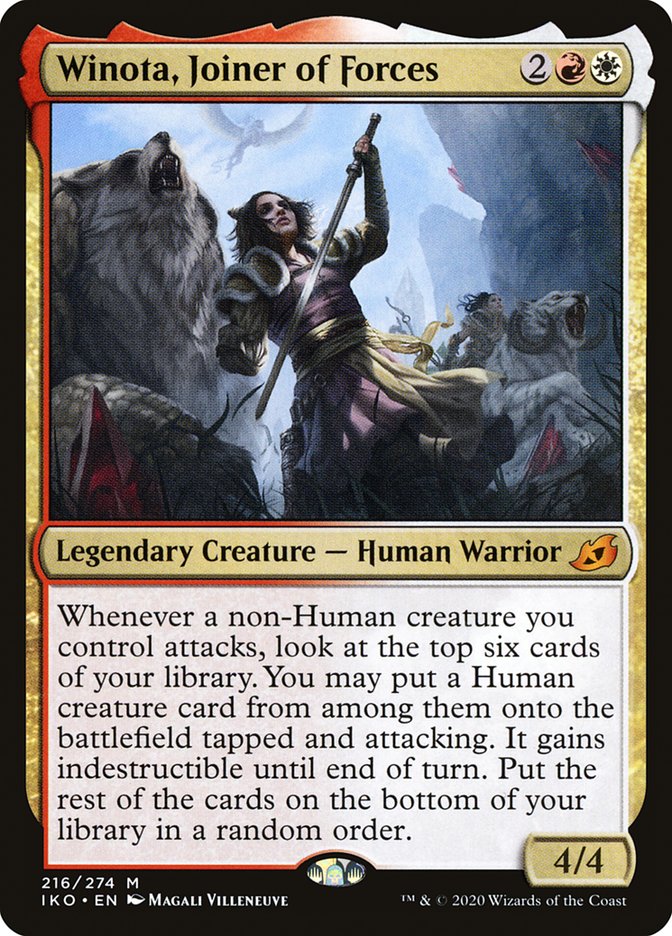
Winota, Joiner of Forces was banned in 2021 after being considered too oppressive for the format. At the time, it applied tremendous pressure from the very first turns and often demanded an immediate answer: without fast interaction before the combat step, games could quickly spiral out of control through multiple triggers generating an overwhelming and difficult to answer board presence.
In the current Duel Commander environment, the overall quality of interaction has improved significantly. Decks now play more efficient and inexpensive spot removal capable of answering Winota immediately, even before it can move to combat. Answers costing two mana or less are now present across most competitive archetypes, greatly reducing Winota’s ability to snowball games uncontested.
It is also important to remember that Winota requires major deckbuilding constraints in order to function properly. The deck must play a very high number of creatures, leaving limited room for interaction. As a result, the archetype tends to be a fairly linear aggressive strategy that is easier to anticipate and prepare against.
Unlike certain combo strategies capable of winning without relying on the battlefield, Winota must commit creatures to the board and go through combat in order to function. This naturally exposes the deck to instant-speed spot removal and the traditional forms of interaction already widely present in the format.
Additionally, the overall power level of Duel Commander has increased considerably since 2021. Many modern commanders now generate immediate value, threaten fast combo kills, or demand immediate answers themselves. In this more explosive environment, Winota no longer appears to be a uniquely problematic outlier from a structural standpoint.
Aggressive strategies are currently struggling against the rise of combo and control decks. The return of Winota could help restore a competitive place for combat-oriented archetypes capable of genuinely punishing slower or greedier strategies.
Its unban could therefore strengthen the strategic diversity of the format by providing aggressive players with a credible alternative and encouraging the return of more proactive creature-based strategies.
For all these reasons, we believe it is now reasonable to allow Winota, Joiner of Forces as a commander.