May 25, 2020 Announcement/Update
May 25, 2020

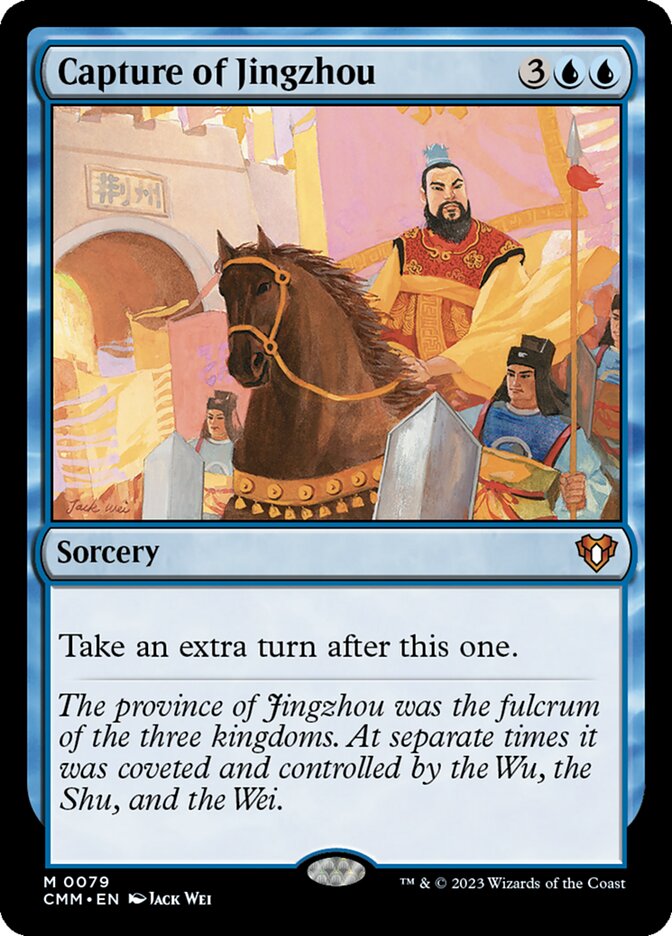
Capture of Jingzhou

Capture of Jingzhou

The existence of functionally identical or near-identical effects poses fundamental challenges for singleton formats. While variety theoretically increases with each printing, excessive redundancy threatens the core principle of variance that defines these formats. Common redundancies exist across many effect categories—burn spells, mana dorks, board wipes, and fetch lands among others.

Such overlap becomes tolerable within Magic's expansive catalog exceeding 27,000 distinct cards. However, certain effect redundancies generate deeply problematic play patterns. Extra turn effects demonstrate this danger particularly well: sufficient density of these effects enables players to sequence them consecutively, establishing complete control over the game's flow. Through recursion and repetition, these strategies create loops where opponents become spectators to extended solitaire sequences. Whether turbocharged via High Tide or cheated into play through alternative casting methods, the result remains consistent—games devolve into one player taking action after action while opponents wait helplessly.

These patterns represent unacceptable gameplay that conflicts with the format's foundational goals.

Key ban reasons:

  • Transforms multiplayer interaction into solitaire gameplay
  • Sufficient redundancy breaks singleton variance requirements
  • Creates lock states through consecutive turn monopolization
  • Synergizes with cost-reduction to enable degenerate sequences
  • Breaks core format philosophy of interactive competition

The three extra turn cards must be banned to protect the integrity of Duel Commander gameplay.
Cavern of Souls

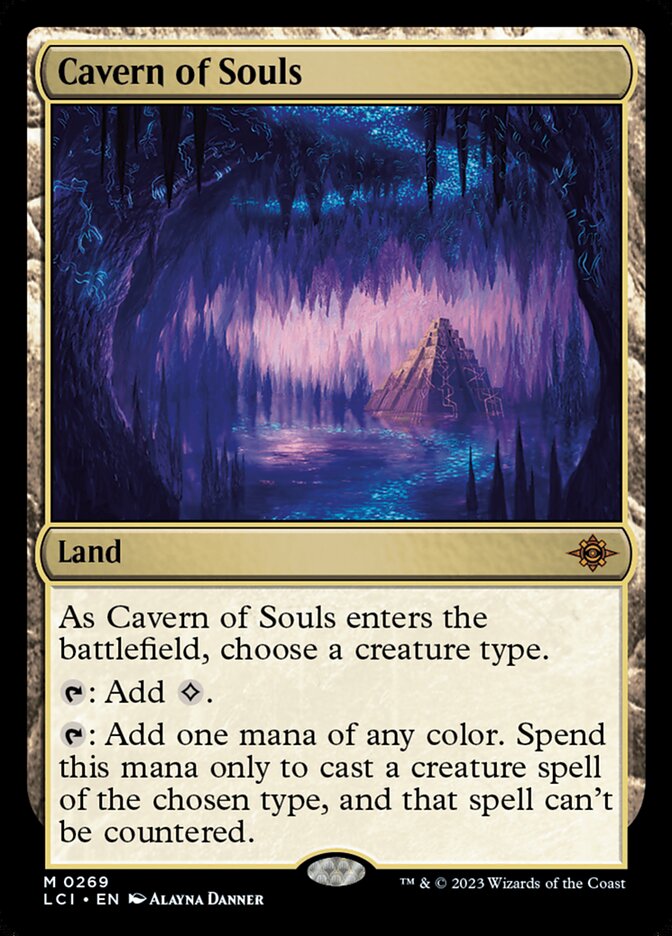
Cavern of Souls

Cavern of Souls greatly favors commander-centric game plans, particularly in green decks that can easily tutor it into play. The card's core problem is that it removes interaction outright: once a commander is uncounterable, spells like Counterspell — interactive cards we value — simply stop mattering. This runs counter to the format's competitive spirit and directly undermines our efforts to position blue as a controlling color rather than a combo-enabling one. Reducing the strategic complexity of the format by making commanders untouchable is not a direction we want to support.

Key ban reasons:

  • Grants unconditional protection from countermagic and similar interaction
  • Easily and consistently tutored for by green decks
  • Removes interaction from the game rather than answering it
  • Reinforces commander-centric strategies over broader strategic diversity
  • Conflicts with positioning blue as a controlling rather than combo color

Cavern of Souls must be banned to preserve interaction as a core format value and to prevent commander-centric strategies from overriding strategic diversity.

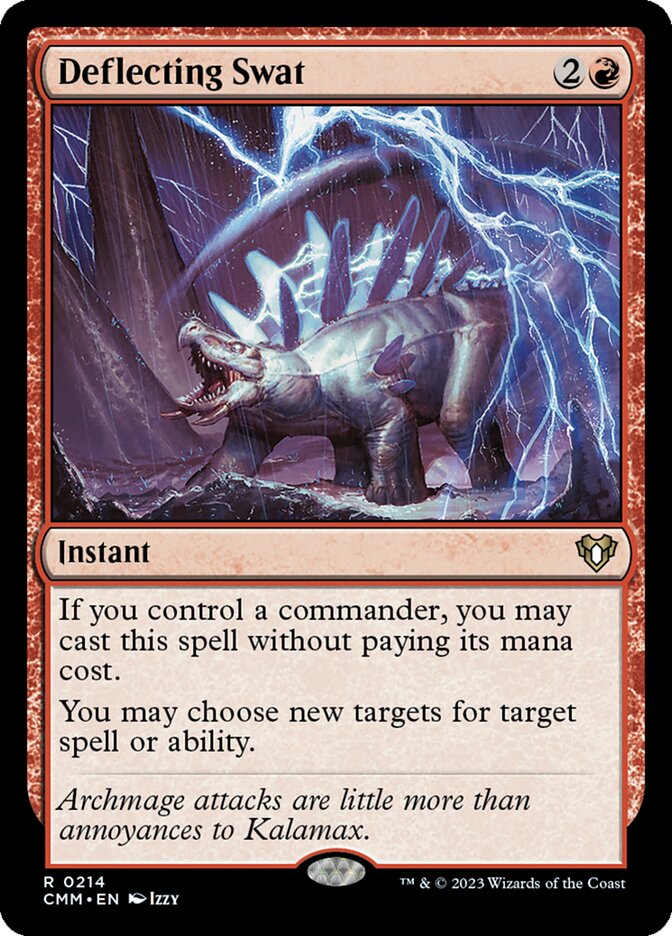
Deflecting Swat

Deflecting Swat

A cycle of five cards from Commander 2020 shares a problematic design pattern: each offers a color-specific effect at both regular and alternative casting costs, with the alternative cost becoming free when controlling a commander. This mechanic exemplifies a recurring issue where cards balanced for multiplayer formats become degenerate in two-player games—similar to past problems with cards like Vial Smasher the Fierce.

While these designs create interesting dynamics in multiplayer environments where multiple opponents provide natural checks and balances, they become trivially easy to exploit in duel formats. The guaranteed presence of commanders transforms their alternative cost from situational to essentially default, making powerful effects consistently free.

Providing costless access to non-creature countermagic and target-redirection effects fundamentally undermines resource management and strategic planning. Commander-focused strategies already possess inherent advantages through guaranteed access to key pieces—they require no additional incentives through free spells.

Key ban reasons:

  • Alternative cost becomes trivial in a format with guaranteed commanders
  • Free countermagic and redirection effects break fundamental game balance
  • Multiplayer design fails to translate appropriately to duel format
  • Further incentivizes already-dominant commander-centric strategies
  • Removes meaningful decision-making around resource allocation
  • Creates unacceptable power level disparities based on commander presence

These cards must be banned to prevent the format from devolving into strategies that abuse free spells enabled by the inherent commander mechanics.

Field of the Dead

Field of the Dead

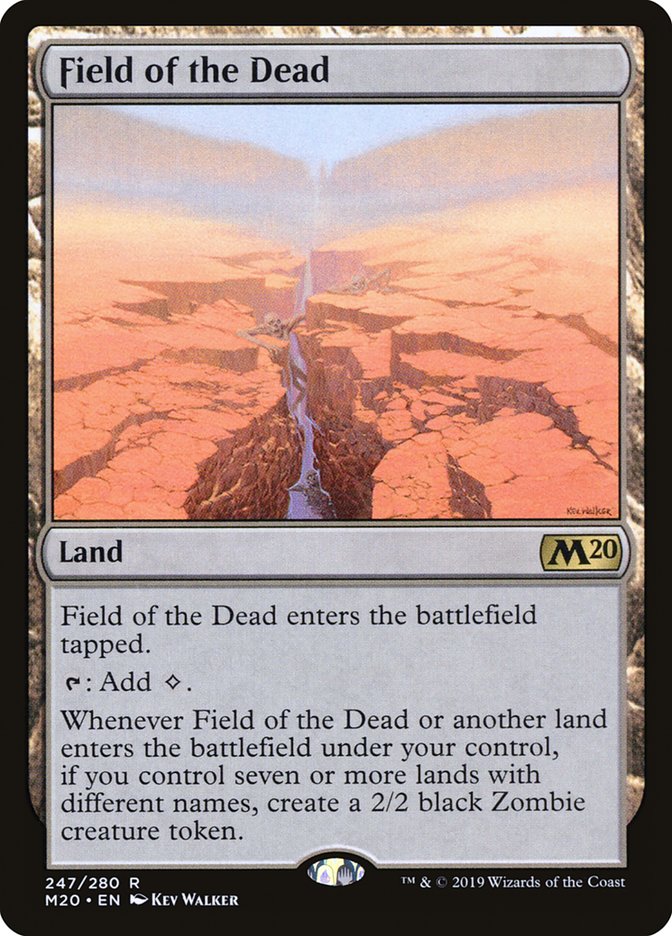
Field of the Dead creates fundamental balance problems across multiple archetypes due to the abundance of tutoring, ramp, and recursion effects available in the format. Commanders like Azusa, Lost but Seeking and Golos, Tireless Pilgrim exemplify how easily this land becomes a recurring engine when accessible from the command zone itself.

The card generates insurmountable inevitability against slower strategies while simultaneously providing endless blockers against aggressive decks. This dual role eliminates traditional weaknesses—control cannot outlast the endless token generation, while aggro cannot push through the defensive wall. The result pushes the entire format toward combo strategies as the only viable response.

A single land producing this level of incremental advantage without meaningful investment warps fundamental strategic relationships. The combination of searchability, recursion, and command zone synergies makes Field of the Dead impossible to balance within the format's existing structure.

Key ban reasons:

  • Generates inevitable victory through free token production
  • Invalidates both control and aggressive strategies simultaneously
  • Excessive synergy with ramp and land recursion effects
  • Command zone access through specific commanders amplifies problems
  • Forces format toward combo as the only viable counter
  • Creates uncounterable advantage engine from land slot
  • Breaks fundamental archetype balance

Field of the Dead must be banned to restore proper strategic diversity and prevent games from devolving into inevitable token-based attrition.

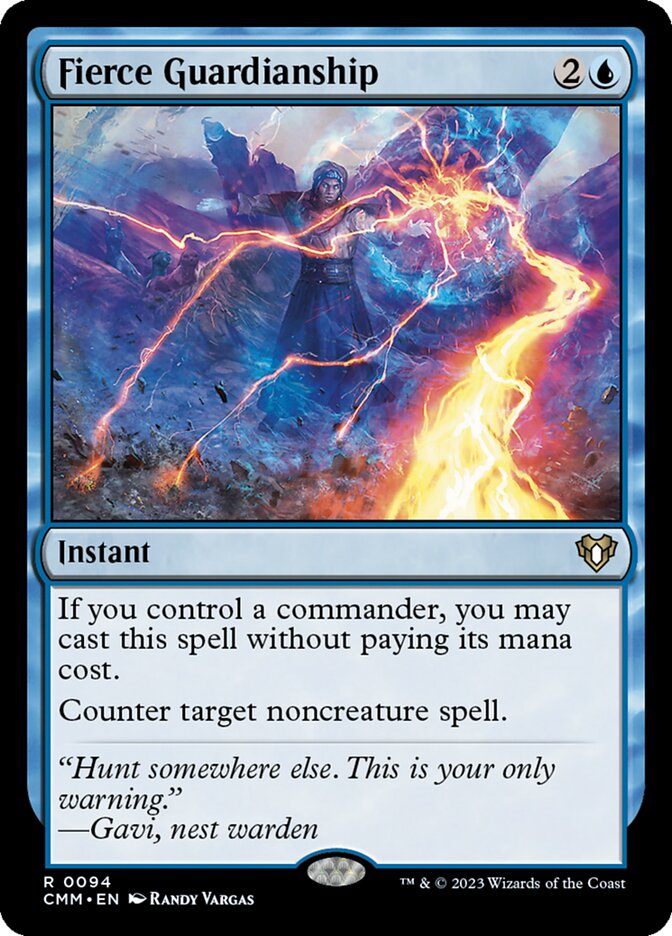
Fierce Guardianship

Fierce Guardianship

Commander 2020 introduced a cycle of five cards sharing a problematic design pattern: each offers a color-specific effect at both regular and alternative casting costs, with the alternative cost becoming free when controlling a commander. This mechanic exemplifies a recurring issue where cards balanced for multiplayer formats become degenerate in two-player games—similar to past problems with cards like Vial Smasher the Fierce.

While these designs create interesting dynamics in multiplayer environments where multiple opponents provide natural checks and balances, they become trivially easy to exploit in duel formats. The guaranteed presence of commanders transforms their alternative cost from situational to essentially default, making powerful effects consistently free.

Providing costless access to non-creature countermagic and target-redirection effects fundamentally undermines resource management and strategic planning. Commander-focused strategies already possess inherent advantages through guaranteed access to key pieces—they require no additional incentives through free spells.

Key ban reasons:

  • Alternative cost becomes trivial in a format with guaranteed commanders
  • Free countermagic and redirection effects break fundamental game balance
  • Multiplayer design fails to translate appropriately to duel format
  • Further incentivizes already-dominant commander-centric strategies
  • Removes meaningful decision-making around resource allocation
  • Creates unacceptable power level disparities based on commander presence

These cards must be banned to prevent the format from devolving into strategies that abuse free spells enabled by the inherent commander mechanics.

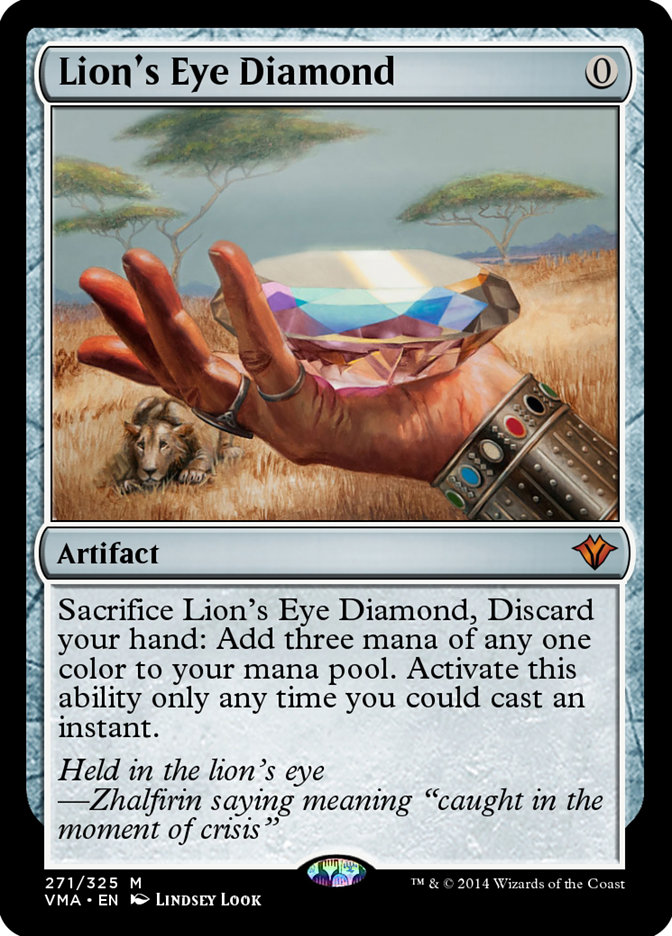
Lion's Eye Diamond

Lion's Eye Diamond

Lion's Eye Diamond enables the format's fastest and most prevalent combo strategies. Players identified it as problematic when it appeared primarily in Tymna the Weaver paired with Thrasios, Triton Hero shells. Additional printings have created more avenues for trivial infinite loops, expanding the card's degeneracy beyond initial concerns.

Unlike creature-based combinations such as Devoted Druid with Vizier of Remedies or Aluren with Recruiter of the Guard, Lion's Eye Diamond combos resist conventional interaction. The artifact's instant-speed activation and graveyard synergies bypass standard removal and countermagic that would stop creature engines.

The card's explosive mana generation combined with minimal interaction points creates unacceptable gameplay patterns. Multiple tier-one strategies rely on this single enabler to achieve consistent early wins.

Key ban reasons:

  • Powers the format's fastest combo kills
  • Enables trivial infinite loops with multiple cards
  • Resists interaction compared to creature-based combos
  • Central to multiple dominant strategies
  • New synergies pushed it beyond acceptable limits
  • Creates non-interactive, explosive gameplay patterns

Lion's Eye Diamond must be banned to reduce combo archetype dominance and restore meaningful interaction windows to the format.

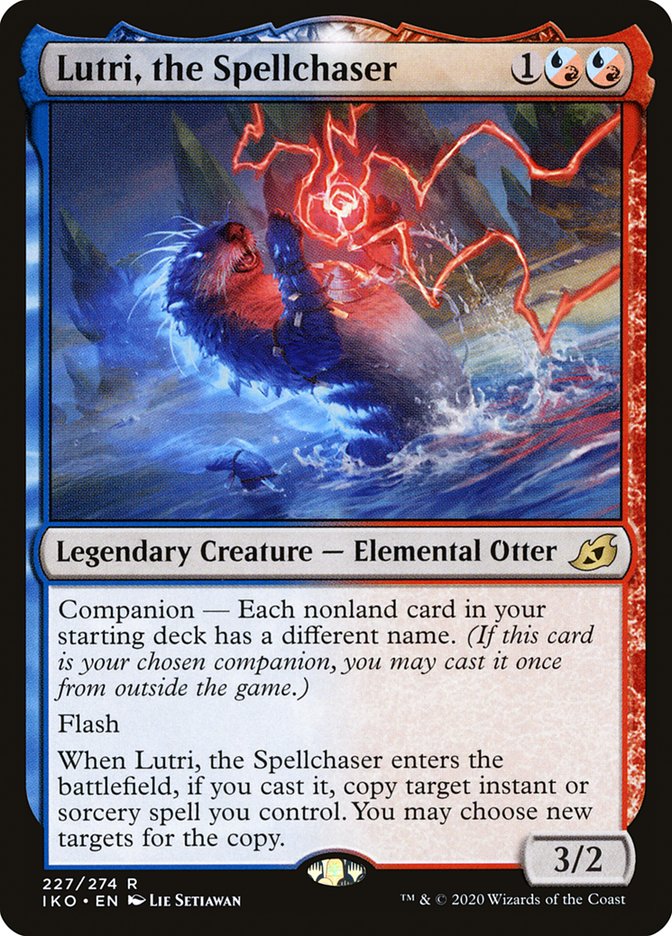
Lutri, the Spellchaser

Lutri, the Spellchaser

Lutri, the Spellchaser presents a unique problem despite being functionally inferior to Dualcaster Mage—a card seeing minimal competitive play. The absence of meaningful deckbuilding restrictions transforms Lutri into an automatic inclusion for any deck containing both colors and cheap spells, providing guaranteed value without opportunity cost.

The fundamental issue centers on competitive equity rather than raw power level. Every player deserves identical deckbuilding options and constraints. Lutri's companion mechanic creates asymmetrical advantages where certain color combinations gain free additional resources while others receive nothing.

This disparity breaks the foundational principle that all players should have access to the same tools and face the same restrictions. The card's existence creates an inherent imbalance regardless of its actual gameplay impact.

Key ban reasons:

  • Creates automatic inclusion without deckbuilding cost
  • Breaks competitive equity between color combinations
  • Provides free value to specific archetypes only
  • Violates principle of equal deckbuilding options
  • Companion mechanic incompatible with format balance
  • Asymmetrical advantage regardless of power level

Lutri, the Spellchaser must be banned to maintain fundamental competitive fairness and ensure all players face identical deckbuilding parameters.

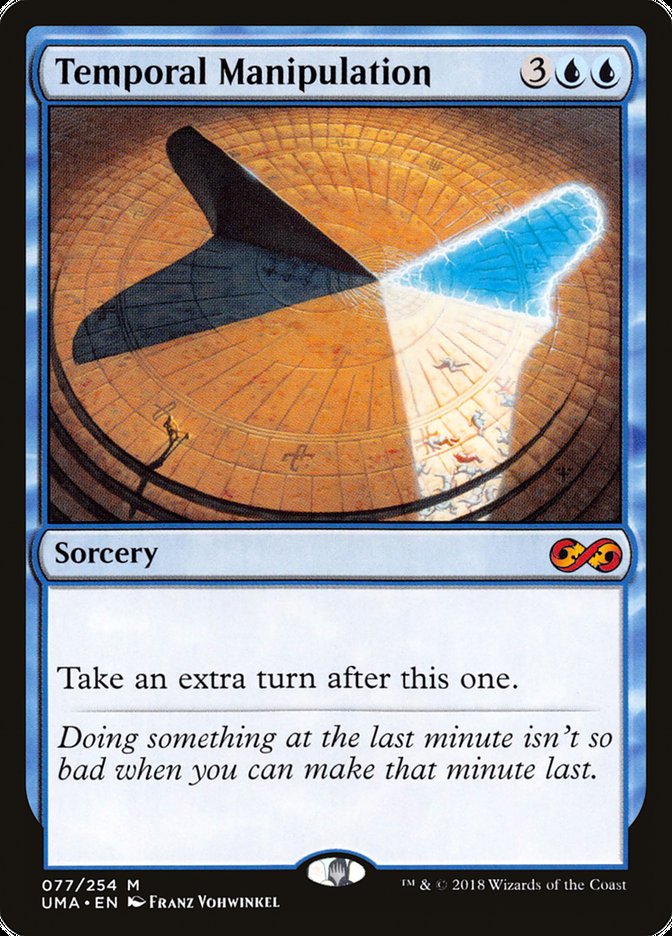
Temporal Manipulation

Temporal Manipulation

The existence of functionally identical or near-identical effects poses fundamental challenges for singleton formats. While variety theoretically increases with each printing, excessive redundancy threatens the core principle of variance that defines these formats. Common redundancies exist across many effect categories—burn spells, mana dorks, board wipes, and fetch lands among others.

Such overlap becomes tolerable within Magic's expansive catalog exceeding 27,000 distinct cards. However, certain effect redundancies generate deeply problematic play patterns. Extra turn effects demonstrate this danger particularly well: sufficient density of these effects enables players to sequence them consecutively, establishing complete control over the game's flow. Through recursion and repetition, these strategies create loops where opponents become spectators to extended solitaire sequences. Whether turbocharged via High Tide or cheated into play through alternative casting methods, the result remains consistent—games devolve into one player taking action after action while opponents wait helplessly.

These patterns represent unacceptable gameplay that conflicts with the format's foundational goals.

Key ban reasons:

  • Transforms multiplayer interaction into solitaire gameplay
  • Sufficient redundancy breaks singleton variance requirements
  • Creates lock states through consecutive turn monopolization
  • Synergizes with cost-reduction to enable degenerate sequences
  • Breaks core format philosophy of interactive competition

These three cards must be banned to protect the integrity of Duel Commander gameplay.
Time Warp

Time Warp

The existence of functionally identical or near-identical effects poses fundamental challenges for singleton formats. While variety theoretically increases with each printing, excessive redundancy threatens the core principle of variance that defines these formats. Common redundancies exist across many effect categories—burn spells, mana dorks, board wipes, and fetch lands among others.

Such overlap becomes tolerable within Magic's expansive catalog exceeding 27,000 distinct cards. However, certain effect redundancies generate deeply problematic play patterns. Extra turn effects demonstrate this danger particularly well: sufficient density of these effects enables players to sequence them consecutively, establishing complete control over the game's flow. Through recursion and repetition, these strategies create loops where opponents become spectators to extended solitaire sequences. Whether turbocharged via High Tide or cheated into play through alternative casting methods, the result remains consistent—games devolve into one player taking action after action while opponents wait helplessly.

These patterns represent unacceptable gameplay that conflicts with the format's foundational goals.

Key ban reasons:

  • Transforms multiplayer interaction into solitaire gameplay
  • Sufficient redundancy breaks singleton variance requirements
  • Creates lock states through consecutive turn monopolization
  • Synergizes with cost-reduction to enable degenerate sequences
  • Breaks core format philosophy of interactive competition

These three cards must be banned to protect the integrity of Duel Commander gameplay.
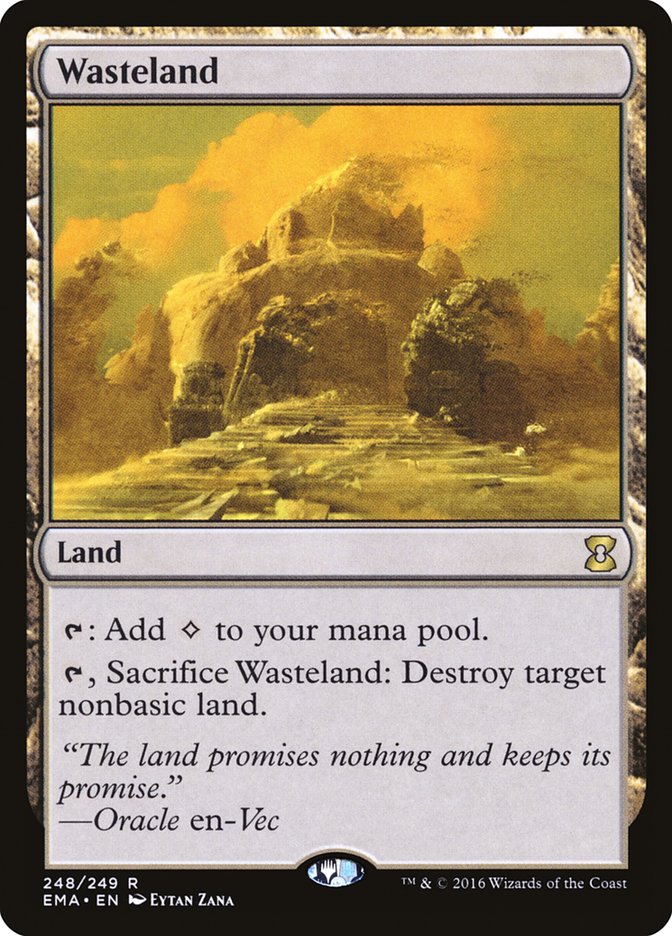
Wasteland

Wasteland

Wasteland operates on three distinct axes, none providing positive format contributions:

First, as problematic land removal. The most egregious lands already face bans, while manageable threats have sufficient answers through Field of Ruin or targeted spells. No land provides solutions to artifacts like Winter Orb or enchantments like Blood Moon—different answers exist for different threats. Commander-centric strategies losing to Maze of Ith represents acceptable counterplay, not format failure.

Second, through recursion engines combining with Life from the Loam, Crucible of Worlds, and similar effects. This creates grinding inevitability that pushes blue strategies toward combo rather than control. Under such inexorable pressure, players abandon interactive control for faster combo victories.

Third, as random mana denial creating non-games through color screw or missed land drops. This variance adds nothing strategic while generating negative play experiences.

These three applications—unnecessary land policing, oppressive recursion loops, and random mana denial—collectively demonstrate Wasteland's detrimental impact.

Key ban reasons:

  • Extreme lands already banned, making Wasteland redundant
  • Recursion creates oppressive inevitability
  • Forces blue toward combo over control
  • Generates random non-games through mana denial
  • Provides no positive strategic contribution
  • Creates negative play experiences across all uses

Wasteland must join Strip Mine on the banned list to eliminate resource denial strategies that reduce games to non-interactive grinds or random mana screw.

← Back to Announcements