Scapeshift
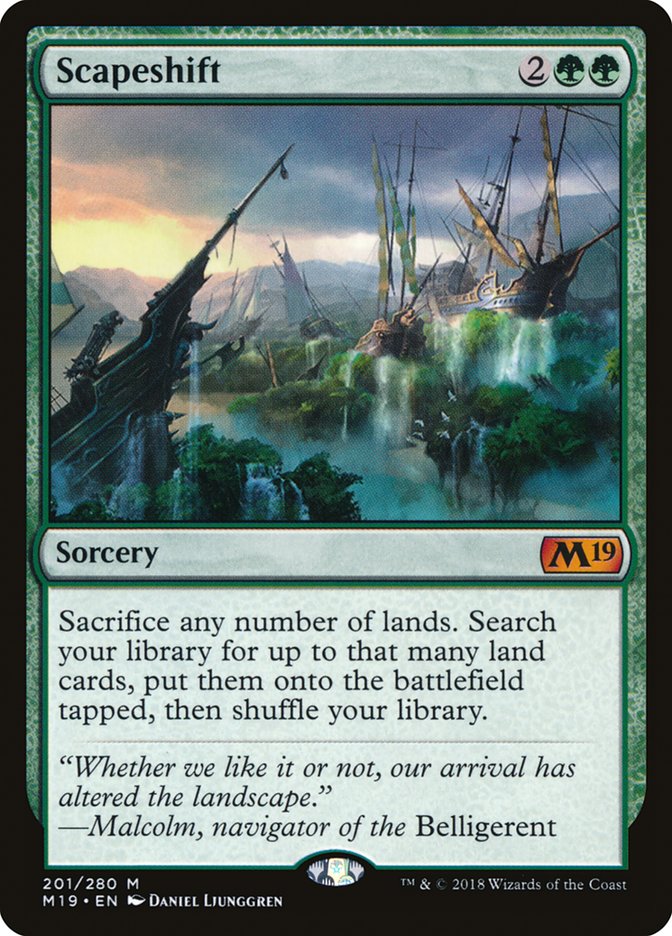
Scapeshift has demonstrated dominance across multiple formats including Modern and Standard, appearing even where unexpected. While its traditional pairing with Valakut, the Molten Pinnacle remained manageable in Duel Commander for years, recent developments fundamentally altered this balance.
Players discovered methods to exploit singleton construction through Scapeshift's mass land exchange. The expanding pool of mountain-typed dual lands combined with various powerful land-based threats transformed Scapeshift into a single-card victory condition. Additionally, numerous new cards triggering off land entries multiplied the spell's potential outputs beyond intended parameters.
Mass tutoring effects inherently conflict with the format's foundational principles—100-card singleton construction relies on variance and diversity. Scapeshift's ability to search and deploy multiple specific lands simultaneously circumvents these core restrictions. Most comparable tutoring effects already face bans for this exact reason, with only the weakest remaining legal.
The convergence of these factors—increased mountain-typed lands, powerful landfall triggers, and fundamental breaking of singleton principles—elevated Scapeshift from acceptable to format-warping.
Key ban reasons:
- Functions as single-card win condition
- Circumvents singleton variance through mass tutoring
- Synergizes with increasingly powerful landfall effects
- Breaks core format principles of diversity
- Creates uninteractive instant-win scenarios
Scapeshift must be banned to preserve singleton integrity and prevent single-card combos that bypass normal gameplay progression.