January 26, 2026 Announcement/Update
January 26, 2026

The format appears healthy, with a decent diversity of decks and archetypes. However, some polarizing strategies pose a risk in the medium term. With the goal of preserving this diversity and continuing to foster its growth, we have decided to implement the following measures: Rograkh, Son of Rohgahh banned as commander. Tasigur, the Golden Fang, Trazyn the Infinite and Necrotic Ooze returns on experimental basis.

⚙️ CHANGES

📘 GLOBAL GAME RULES CHANGES

• No changes.

📘 INDIVIDUAL BANNED AND RESTRICTED CARD CHANGES

Rograkh, Son of Rohgahh is now banned as commander only.

📘 EXPERIMENTAL CHANGES

Tasigur, the Golden Fang is now legal.

Trazyn the Infinite is now legal.

Necrotic Ooze is now legal.

📘 OTHER CHANGES

• No changes.

You can contact us on our Reddit page and our Discord server.

Rograkh, Son of Rohgahh

Rograkh, Son of Rohgahh

Six months after our intervention on the Rograkh, Son of Rohgahh // Tevesh Szat, Doom of Fools Storm archetype, marked by the banning of Dark Ritual and Underworld Breach. We observe that the deck has reinvented itself and remains a consistently top-performing strategy. The list has evolved by adopting Ikra Shidiqi, the Usurper in place of Tevesh Szat, Doom of Fools, altering its play patterns without meaningfully reducing its overall power.

While the loss of Tevesh has diminished the deck’s resilience and its ability to thrive in longer games, access to green has significantly increased its speed, even in the absence of Dark Ritual. New sources of mana acceleration, along with the ability to run a higher density of Swamps, have strengthened the use of Lake of the Dead, further consolidating an explosive game plan from the earliest turns.

The loss of Underworld Breach has also been offset by a new approach: developing five, six, or more Dragons early in the game through Stormscale Scion or Elemental Eruption. The green splash provides both additional acceleration and new tutor options, effectively stabilizing access to this line of play.

This strategic shift raises significant concerns with respect to interactive counterplay. Whereas graveyard hate previously served as an effective means of slowing the Storm deck, the current build can often bypass such disruption depending on hand composition. As a result, this evolution substantially narrows the range of interactive tools available to opponents, leaving them to contend with an increasingly linear game plan that is difficult to meaningfully disrupt.

Moreover, we have observed that the deck’s presence in the metagame continues to grow.

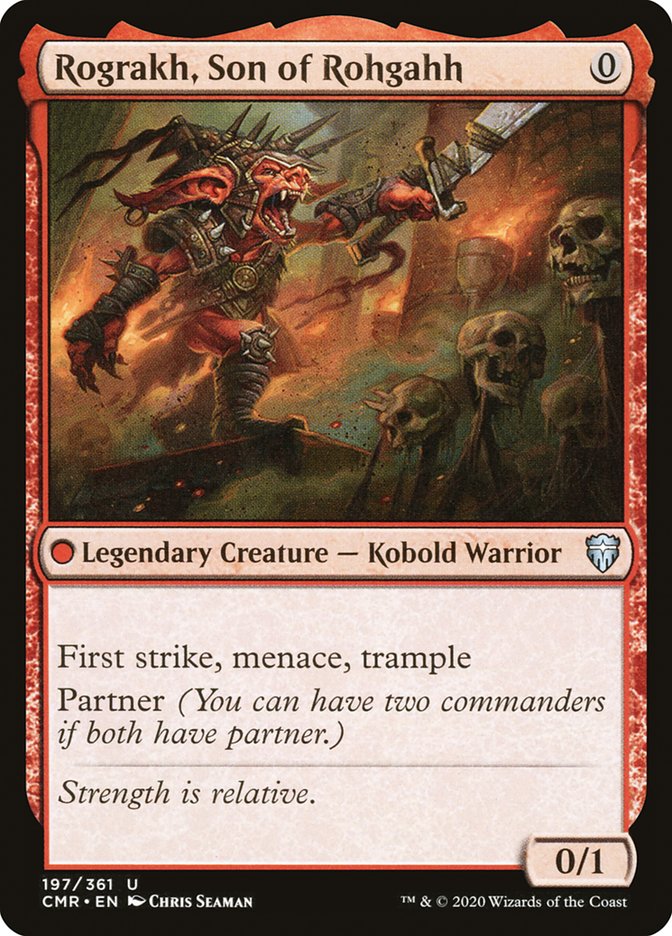
A zero-mana commander effectively negates the additional costs on many key cards that provide the deck’s speed (such as Culling the Weak, Diabolic Intent, Flare of Duplication, or Infernal Plunge). This structural uniqueness allows the deck to exploit these effects far more efficiently, and essentially for free, than any other combination of commanders. Taken together, these factors place the deck at a power level we consider unacceptable for the format.

We’ve concluded that Rograkh, Son of Rohgahh is the true cornerstone of these strategies. It functions as the most effective enabler of early explosive turns, capable of securing kills as early as turn three, while remaining difficult for most decks to disrupt without very specific hate pieces.

For all these reasons, Rograkh, Son of Rohgahh is now banned as commander only.
Tasigur, the Golden Fang

Tasigur, the Golden Fang

For several months, we have observed a noticeable decline in the performance of control archetypes. A clear trend has emerged: to remain competitive, most control decks have been forced to incorporate combo finishes (such as Atraxa, Grand Unifier + Dream Halls, Ertai Resurrected + Parallax Tide, or Glarb, Calamity's Augur + Thought Lash) and/or rely on commanders with high mana costs (Atraxa, Grand Unifier, Tivit, Seller of Secrets) that can quickly end the game once resolved.

However, this evolution comes with a significant structural cost. These approaches tend to make decks more linear and therefore easier to target, while also creating situations in which the control player must repeatedly answer opposing commanders before being able to deploy their own. This dynamic results in a form of virtual card disadvantage and leads to an increasing number of games where the control deck’s commander cannot be cast at all. At the same time, these decks must contend with a growing range of threats whose power, speed, and autonomy have increased in recent years.

More recent attempts (particularly those involving low-cost commanders such as Thrasios, Triton Hero/Tymna the Weaver or Bruse Tarl, Boorish Herder) have sought to address these issues by offering a more accessible Command Zone that generates card advantage throughout the game. However, we have found that these solutions are insufficient to restore control to a sustainable position within the current metagame.

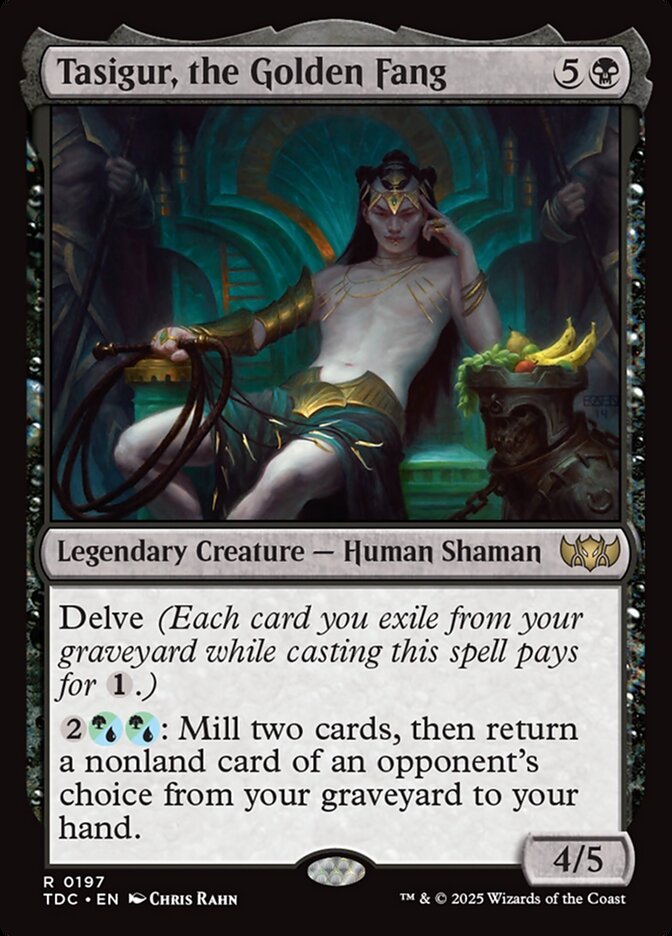
In this context, Tasigur, the Golden Fang represents an interesting option for revitalizing the archetype. The overall pace of the format has accelerated significantly, the sizing of creatures and the quality of removal spells has improved : as a result, Tasigur, the Golden Fang’s body is no longer as decisive as it was at the time of his banning. His activated ability, while capable of generating resources, remains sufficiently mana-intensive to avoid creating excessive value. Tasigur, the Golden Fang also provides control decks with a faster clock, which may prove to be a meaningful shift in certain matchups.

Furthermore, the graveyard has become a highly contested resource, and the vast majority of decks already have access to graveyard hate capable of effectively limiting Tasigur, the Golden Fang’s access to the Command Zone.

Tasigur, the Golden Fang’s use of the delve mechanic also imposes genuine strategic constraints on deck construction and in-game decision-making. Unlike other graveyard-based threats, delve forces the pilot to make deliberate choices about how the graveyard is allocated. Cards that traditionally exploit the graveyard as an additional resource, such as Abhorrent Oculus or Murktide Regent, which are often easy and efficient win conditions to incorporate, come at a real opportunity cost in a Tasigur, the Golden Fang deck.

Tasigur, the Golden Fang has a contained and easily monitored risk profile. Its archetype is well understood, and its impact on the metagame can be tracked efficiently, allowing for prompt reassessment if necessary.

For all these reasons, Tasigur, the Golden Fang is now legal again as a Commander.

Trazyn the Infinite

Trazyn the Infinite

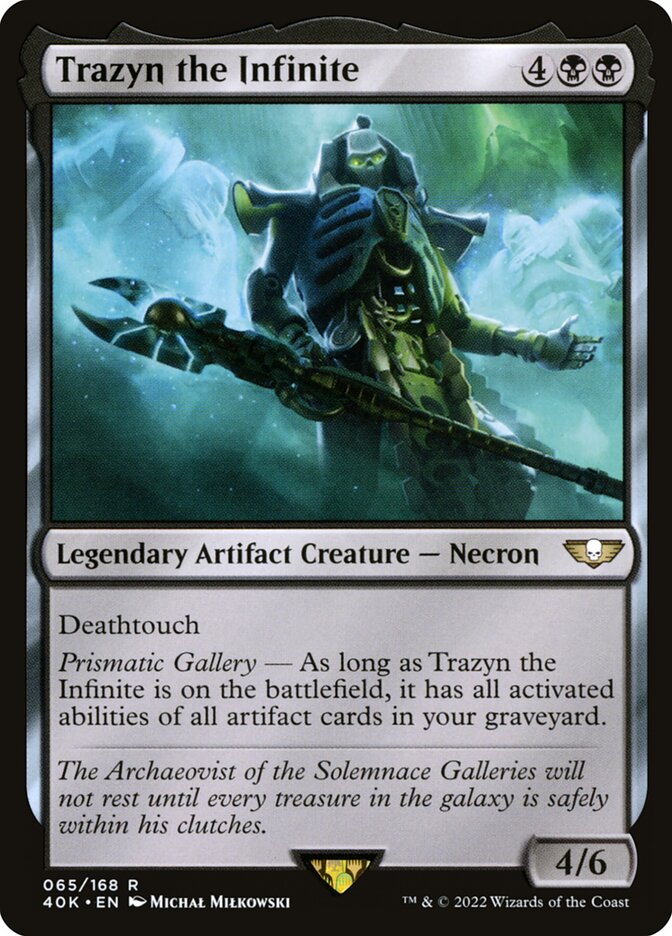
Trazyn the Infinite was banned in March 2023 to reduce the power of the Old Stickfingers deck, whose Command Zone was subsequently banned in July 2024. At the time, the combination of Trazyn the Infinite, Walking Ballista, and Phyrexian Devourer proved excessively powerful within the context of a mass-entomb strategy enabled by the Old Stickfingers Command Zone.

Without the support of this mass-entomb engine, assembling all the pieces for the combo becomes significantly more difficult, whether Trazyn the Infinite is in the Command Zone or in the deck. Executing this plan requires playing three relatively low-impact cards independently, with at least two of them ending up in the graveyard. The most effective known enablers (Survival of the Fittest and Buried Alive) require substantial mana investment, and the combo is generally not achievable before turn four. Even then, it remains highly vulnerable to graveyard hate.

Players now have access to more interactive tools, including more efficient graveyard hate already included in decks. This level of interaction substantially reduces the resilience and reliability of the Trazyn the Infinite combo.

Considering the opportunity cost of including these cards, the speed of the combo in the current format, and the fragility of the plan, the strategy aligns with what the format can reasonably accommodate. Moreover, Trazyn the Infinite has not yet been fully explored as a commander, and his unbanning could encourage the construction of original and diverse decks.

For all these reasons, Trazyn the Infinite is now legal again.

Necrotic Ooze

Necrotic Ooze

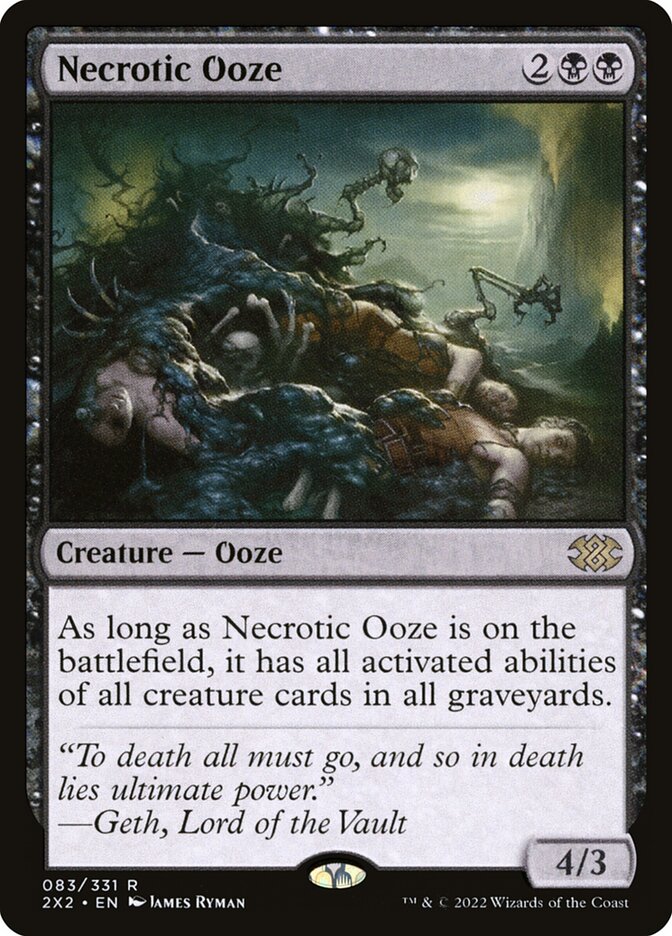
Necrotic Ooze was initially banned due to its interaction with explosive combos involving Phyrexian Devourer and Triskelion, whose activated abilities could be copied from the graveyard. At the time, these interactions were considered both too powerful and too easy to assemble in an environment that was slower, less hostile, and less focused on graveyard strategies. The card was also appearing in decks that were already strong in the metagame, such as Sidisi, Undead Vizier and other GBx builds.

The format has since evolved significantly. Graveyard hate is now widespread and are more integrated into decks, naturally limiting strategies that rely heavily on the graveyard. This structural shift reduces the situations in which Necrotic Ooze can realize its full potential.

Setting up Ooze-related combos also carries a meaningful opportunity cost: players must include multiple cards that are relatively ineffective on their own and have access to specific tools to feed the graveyard. Like with Trazyn the Infinite, these combos are unlikely to be achievable before turn four. Outside of these carefully constructed configurations, Necrotic Ooze and its associated combo pieces can become undesirable draws, reducing the overall stability of the deck.

Trazyn the Infinite duplicates Necrotic Ooze’s role in different contexts. Ooze is cheaper, but must come from the deck, adding an extra piece to the combo. This redundancy provides interesting possibilities for certain midrange decks, which can now incorporate a secondary graveyard-based combo plan without committing entirely to it.

We believe that all of these factors place Necrotic Ooze at an acceptable power level for the current format. Its effectiveness depends on precise deckbuilding, a permissive environment, and the absence of graveyard hate, conditions that are significantly harder to achieve than when it was originally banned.

For all these reasons, Necrotic Ooze is now legal.

← Back to Announcements